You’ve probably seen the recent news about glyphosate.
On February 18, 2026, the White House signed an executive order invoking the Defense Production Act. This EO mandates and protects the domestic production of glyphosate-based herbicides. Glyphosate is the active ingredient in Roundup, the most widely used herbicide in the United States. This order compels continued production of glyphosate. It shields the manufacturers from certain civil lawsuits. And it directs federal agencies to prioritize protecting the industry’s viability over other considerations, like your family’s health.
I want to share something with you that I have been sitting with for the past few weeks. You don’t have to live in fear. I strongly believe that awareness is the first step toward making empowered choices for yourself and your family. My goal, as always, is to help you understand what is happening in our food and health environment. This allows you to respond thoughtfully and with confidence.
I want to walk you through what glyphosate is, what the science tells us about it, what this order means for our everyday lives, and most importantly, what we can do about it.
Because there is so much we can do.

What Is Glyphosate?
Farmers have sprayed glyphosate, a broad-spectrum herbicide, on the majority of U.S. staple crops, including corn, soybeans, wheat, and oats, for decades. Growers often apply it directly to crops right before harvest as a “drying agent” to speed processing, meaning it is not just in the soil; it is on and in the food itself.
And research confirms it has made its way into our bodies.
In a study published through the CDC’s National Health and Nutrition Examination Survey (NHANES), researchers tested urine samples from over 2,310 Americans and found that more than 80% contained detectable levels of glyphosate. When researchers specifically examined children’s samples, that number rose to 87%. The Environmental Working Group reported these findings in 2022, with scientists describing the results as “disturbing” and “concerning.”
This is the CDC’s own data. This knowledge empowers us to make wise choices — not from a place of fear, but from a place of clarity and awareness.
What the Research Tells Us About Glyphosate and Health
In 2015, the International Agency for Research on Cancer (IARC), a division of the World Health Organization, classified glyphosate as a Group 2A probable human carcinogen, with a specific connection to non-Hodgkin lymphoma. This classification reflects a significant body of scientific evidence, and the research has continued to build since then.
A 2019 peer-reviewed meta-analysis published in Mutation Research by researchers at the University of Washington, pooling results from six major epidemiological studies, found that people with the highest glyphosate exposure had a 41% increased risk of developing non-Hodgkin lymphoma. This is a statistically significant finding, replicated across multiple independent studies.
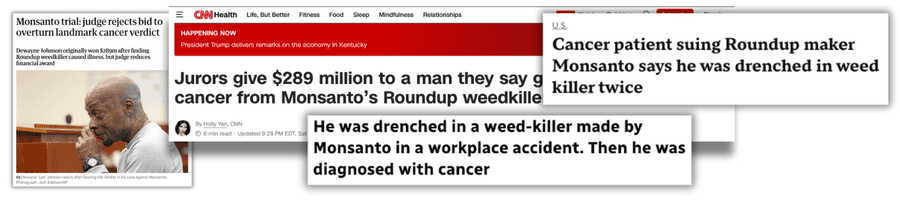
The human stories behind these numbers are meaningful. Dewayne Lee Johnson, a school groundskeeper who used Roundup daily, developed non-Hodgkin lymphoma and won a $289 million jury verdict against Monsanto in 2018.
The jury concluded that Monsanto knew glyphosate caused cancer and deliberately withheld that information from users. Lindebald v. Monsanto and Walsh v. Monsanto, two additional cases involving golf course superintendents who developed cancer after regular Roundup exposure. It is worth noting that over 3 million homes sit adjacent to golf courses in the United States, where families regularly encounter chemical runoff from treated turf.
People who developed non-Hodgkin lymphoma after Roundup exposure have filed over 125,000 lawsuits against Bayer-Monsanto, and Bayer has paid out more than $10 billion in settlements. The company maintains that glyphosate does not cause cancer, yet continues to settle claims.
Glyphosate Studies
In 2025, researchers from Boston College’s Program for Global Public Health and the Common Good published a study finding that glyphosate caused multiple cancers in rats. And one of the major studies previously used to argue glyphosate was safe was retracted from the journal Regulatory Toxicology and Pharmacology after it was discovered that Monsanto scientists had helped write it, gather data for it, and review it, with other named authors having been financially compensated by the company. The journal cited “serious ethical concerns regarding the independence and accountability of the authors.”
Beyond cancer risk, glyphosate functions as a patented antibiotic. It disrupts a specific metabolic pathway in plants, and that same pathway exists in the bacteria that make up the human microbiome. Even at low doses, it can disturb the balance of gut bacteria, contributing to inflammation, immune dysfunction, and a range of downstream health effects. Since the gut is so foundational to our immunity, mental health, and overall vitality, I think about this deeply in my practice.
What the Glyphosate Executive Order Actually Means
The executive order signed on February 18th has a few practical dimensions worth understanding.
It uses the Defense Production Act, a law historically reserved for wartime manufacturing emergencies, to compel Bayer-Monsanto to continue producing glyphosate. The company reportedly weighed whether to stop production amid mounting legal liability. This order removes that option.
It also shields companies that comply with the order from civil liability, making it more difficult for individuals harmed by glyphosate exposure to pursue legal accountability. The order additionally directs the USDA to ensure that no rule or regulation “places the corporate viability of any domestic producer of elemental phosphorus or glyphosate-based herbicides at risk,” which could limit future regulatory action.
This decision has drawn bipartisan concern. Former Rep. Marjorie Taylor Greene called this order “an EO protecting cancer-causing glyphosate in our foods.” Ken Cook, president of the Environmental Working Group, said this was deeply at odds with the goals of the Make America Healthy Again (MAHA) movement.
This Pattern Is Not New: The Agent Orange Parallel
Understanding the full picture here requires a brief look at history, because this is not the first time this company has navigated a situation like this.
In 1949, a pressure valve blew at Monsanto’s chemical plant in Nitro, West Virginia, where the company was manufacturing 2,4,5-T, the active ingredient that would later become part of Agent Orange. Workers were exposed to dioxin and began experiencing severe illness. A medical report concluded it “caused a systemic intoxication in the workers involving most major organ systems.” Internal documents later revealed the company was aware of the danger and chose not to disclose it.
As documented through thousands of pages of internal records now known as the “Poison Papers,” obtained via FOIA requests and archived by the Bioscience Resource Project, Monsanto knew about the toxic dangers of dioxin and worked to conceal them. A 1965 internal memo from Dow Chemical, another Agent Orange manufacturer, documented a secret meeting of chemical industry executives, including Monsanto, in which they discussed the “extraordinary danger” of dioxin contamination. Dow official V.K. Rowe sent a follow-up memo to a colleague confirming that dioxin was “exceptionally toxic” with a “tremendous potential for producing chloracne and systemic injury,” adding in a postscript: “Under no circumstances may this letter be reproduced, shown, or sent to anyone outside of Dow.”
Lasting Effects of Warfare
The U.S. military sprayed more than 20 million gallons of Agent Orange across 6 million acres of Vietnamese forest between 1962 and 1971. Approximately 2.6 million American military personnel were exposed. An estimated 500,000 Vietnamese children were born with birth defects attributed to Agent Orange exposure. As public concern grew and the EPA began considering restrictions, Monsanto sponsored its own studies of the Nitro workers to demonstrate that no significant health effects were observed.
Later investigation found that the authors had omitted deaths from the exposed group and misclassified exposed workers as unexposed to change the outcome. EPA chemist Dr. Cate Jenkins documented what she called “a deliberate course of conduct by Monsanto through altered research.” The Bioscience Resource Project’s analysis of the Poison Papers found that the EPA also concealed its own internal studies finding high dioxin levels and that agency officials held secret meetings acknowledging dioxins were “extraordinarily poisonous” while publicly failing to regulate them.
The Response
In 1984, seven chemical companies, including Monsanto and Dow, settled for $180 million in a class action covering an estimated 10 million affected people, working out to roughly $3,800 per person. After that settlement, companies facing individual claims reached for the government contractor defense: the argument that, because they were producing the product under a government contract, they could not be held liable. Many veterans who had opted out of the settlement or became ill later found they had no legal avenue forward.
Bayer announced a class-action settlement to cover current and future glyphosate-related cancer injuries, and shortly after, this new Defense Production Act order required Bayer to produce glyphosate under government authority. Bayer’s public statement was: “We will comply with this order to produce glyphosate and elemental phosphorus.” The order explicitly grants immunity from civil liability to companies that comply with it. The structural parallel to the Agent Orange legal strategy is something I think we all deserve to be aware of.
I share this history not to leave you feeling helpless, but because awareness of patterns gives us wisdom and clarity about what we are navigating.
Reasons for Hope: How Congress Is Responding to the Glyphosate Executive Order
Something meaningful is happening in response to this order, and I want you to know about it.
Republican Rep. Thomas Massie of Kentucky and Democratic Rep. Chellie Pingree of Maine have introduced the bipartisan “No Immunity for Glyphosate Act” (HR 7601) specifically to undo the liability protections granted by the executive order. The bill would prohibit the use of federal funds to implement the order and confirm that glyphosate manufacturers cannot claim immunity from civil liability. Rep. Nancy Mace of South Carolina has joined as a co-sponsor.
Rep. Massie stated: “The federal government should not be using its authority to promote or protect the production of glyphosate.”
Rep. Pingree said, “Chemical companies do not get immunity.”
Rep. Pingree has called fighting Bayer’s lobbying efforts a “hard fight,” and she has also noted that the MAHA coalition has become “the first time we’ve had a fairly significant advocacy group working on the Republican side” to push back against Big Chemical. These are signs that the public voice matters here.
What You Can Do to Protect Your Family from Glyphosate
This is always where I want to spend the most time, because this is where our real power lives. Regardless of what happens in Washington, there is so much within our reach every single day.
- Choose organic on the highest-risk foods. The EWG’s Dirty Dozen is the best starting point for conventional produce to avoid. Pay special attention to oats, wheat, soy, and corn. These are routinely sprayed with glyphosate right before harvest as a drying agent. Choosing certified organic versions of these staples makes a meaningful difference. You can also check out this guide I wrote for 15 Ways to Eat Organic on A Budget.
- Filter your drinking water. Glyphosate has been detected in tap water sources across the country. When choosing a water system for our entire property in Hawaii, we chose an NSF certified water filtration system that removes up to 99% of lead and 67 other contaminates including asbestos, pharmaceuticals, chloramines, PFOA & PFOS, herbicides and pesticides like glyphosate, industrial solvents, mercury, and other volatile organic compounds (VOCs).
- Nourish your gut microbiome intentionally. Support the microbiome with both a prebiotic and a probiotic. These help feed beneficial bacteria and restore balance in the gut. Add sprouts such as alfalfa, red clover, broccoli, and sunflower sprouts. They supply enzymes, minerals, and compounds that support microbial growth. Eat plenty of raw fruits and vegetables and rotate a wide range of fiber sources. This ensures that different strains of gut bacteria receive nourishment. Remove processed foods and refined sugars, since they feed harmful microbes and disrupt balance in the gut. Focus meals around whole food and plant based ingredients. These provide the fiber, polyphenols, and nutrients the microbiome uses to rebuild and maintain a stable digestive environment.

- Consider Purium’s Biome Medic. This is a product I recommend with great confidence. Biome Medic was specifically formulated to address glyphosate’s impact on the gut. It contains a targeted blend of probiotics, prebiotics, and humic acid. These are designed to protect the microbiome and support the body’s natural elimination of glyphosate. A published pilot study showed measurable reductions in urinary glyphosate levels in participants after 90 days of use. I take it, and I give it to my family.
- Read your labels. The Non-GMO Project Verified and USDA Certified Organic seals are your most reliable tools at the grocery store.
- Support organizations doing this work. The Environmental Working Group, Moms Across America, and the Center for Food Safety are all fighting for stronger protections. Your voice and your support genuinely matter.
- Let HR 7601 hear from you. Contact your congressional representative and let them know you support the No Immunity for Glyphosate Act. Change does happen when people speak up, and this bill is direct evidence of that.
- Reconsider Roundup at home. If it is in your garage, I would lovingly encourage you to let it go. Natural vinegar-based weed killers is an effective, safe alternative.
A Closing Thought
When I come across information like this, my first instinct is always to ask: what can I do? As with all my work, I never want to carry fear forward. The body is deeply resilient, and so are we as a community.
The same government that once called Agent Orange safe eventually acknowledged the truth. Fortunately, the same regulatory patterns that protected industry eventually gave way to accountability. Progress is rarely fast or easy, but it is real.
What we eat, how we support our gut health, the choices we make at the grocery store, the voices we raise for our communities — these things matter. They accumulate. They create change, quietly and consistently, the same way the body heals when we give it what it needs.
Hear this: you are not powerless in this. Your daily choices are a form of advocacy. And the more informed we are, the more clearly we can act.
Share this with someone who needs to know. Support the people around you. And as always, come back to the things you can control. Clean food, clean water, and a supported gut, are the hallmarks of a community that cares.
I believe in the body’s ability to heal. I believe in ours, too.
———
Disclaimer: This post reflects my personal research, opinions, and experience and is not intended as medical advice. Please work with a qualified healthcare provider for personalized guidance. Product recommendations reflect my own experience and are not a substitute for professional medical care.